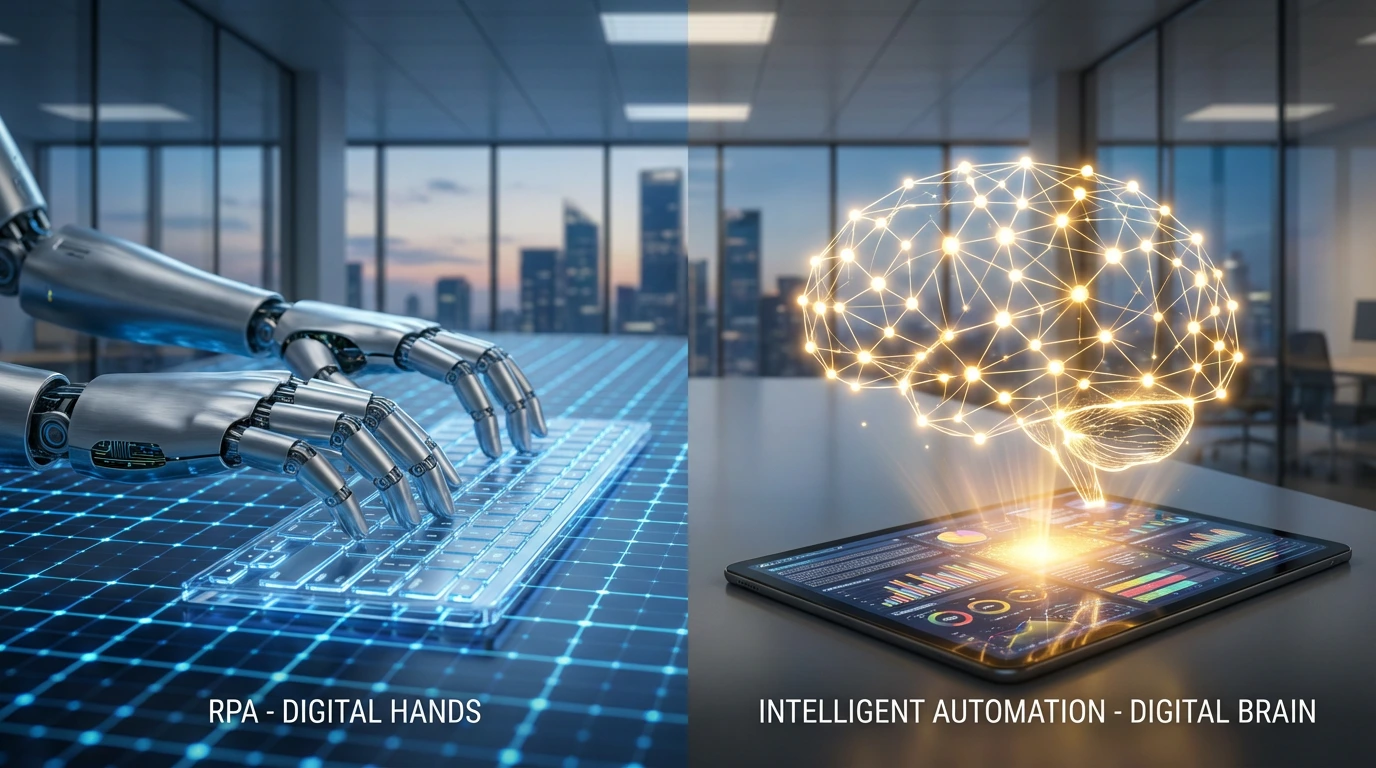
The Strategic Dilemma for Operations Leaders
It is 2025, and the pressure on operations teams has never been higher. Your team is likely drowning in manual data entry, reconciling endless spreadsheets, and moving files between legacy systems that refuse to talk to each other. You know the solution is automation.
But when you survey the market, you are bombarded with jargon. Vendors pitch RPA (Robotic Process Automation) as the silver bullet, while others insist that Intelligent Automation (IA) or "Hyperautomation" is the only way forward.
Are they the same thing? No. Can you use them together? Yes. Which one drives better ROI? It depends entirely on the problem you are solving.
For enterprise leaders in India and abroad, choosing the wrong tool is expensive. Buying RPA for a complex, unstructured problem is like hiring a data entry clerk to solve a calculus problem—it simply won’t work. Conversely, deploying expensive AI for a simple file-transfer task is massive over-engineering.
This guide serves as your definitive playbook for 2025. We will strip away the marketing hype, dissect the technical differences, and provide a clear framework to help you choose the right stack for your business.
RPA: The "Digital Hands" of the Enterprise
Think of Robotic Process Automation (RPA) as a highly efficient, tireless digital intern. It is fantastic at following strict rules, but it cannot think, learn, or deviate from the plan.
RPA bots mimic human interactions with a user interface. They click buttons, copy-paste text, and type into fields just like a human would—only they do it 24/7 without taking a coffee break.
How It Works
RPA operates on structured data and logic-based rules.
- If an email arrives with the subject line "Invoice," then download the attachment.
- If the cell is A1, then copy to Field B2 in the ERP.
Best Use Cases for RPA
RPA shines in high-volume, repetitive environments where the process never changes.
- Invoice Processing (Standardized): If your vendors send invoices in the exact same PDF format every time, RPA is perfect.
- Employee Onboarding: Creating email IDs, adding users to Slack, and setting up payroll entries based on a standard form.
- Data Migration: Moving clean data from a legacy Oracle system to a new SAP environment.
- Server Monitoring: Periodically checking server status and sending an alert if a threshold is crossed.
The Critical Limitation: Fragility
The biggest downside of RPA is its fragility. It lacks "vision." If a website button moves three pixels to the right, or if a vendor changes the font on an invoice, the bot fails. It cannot "see" the change; it only knows that the button isn't where it was programmed to be. This leads to the "Break-Fix" cycle, where IT teams spend hours maintaining bots that keep breaking due to minor UI updates.
Intelligent Automation: The "Digital Brains"
Intelligent Automation (IA)—often referred to as Hyperautomation—is what happens when you give RPA a brain. It is the convergence of RPA with cognitive technologies like Generative AI, Machine Learning (ML), Computer Vision, and Natural Language Processing (NLP).
IA doesn't just move data; it understands it. It creates a cognitive layer that sits on top of the execution layer.
The "Cognitive" Upgrade
While RPA handles the "doing," IA handles the "thinking."
- Computer Vision: Allows the bot to "read" a scanned PDF or a handwritten note, even if the layout changes.
- NLP (Natural Language Processing): Allows the bot to understand the sentiment of a customer email (e.g., "This customer is angry") and route it to a priority queue.
- Machine Learning: Allows the bot to learn from historical data. If it sees a new type of invoice, it can make a probabilistic guess on where the "Total Amount" is, rather than crashing.
Best Use Cases for Intelligent Automation
- Customer Support Agents: A bot that reads incoming emails, understands the intent (Refund vs. Technical Issue), drafts a response using GenAI, and asks a human to approve it.
- Fraud Detection: Analyzing millions of transaction patterns in real-time to flag anomalies that don't fit the standard rulebook.
- Dynamic Supply Chain: Predicting shipping delays based on weather data and news reports, and automatically rerouting logistics.
- Legal Contract Review: Scanning thousands of pages of legal documents to extract specific clauses, regardless of how they are phrased.
The Comparison Matrix: At a Glance
To make the right investment, you need to compare the capabilities side-by-side.
Feature
RPA (Robotic Process Automation)
Intelligent Automation (GenAI + RPA)
Primary Function
Doing (Execution)
Thinking (Decision Making)
Data Type
Structured Data (Excel, DBs)
Unstructured Data (Emails, PDFs, Voice, Images)
Flexibility
Rigid (Breaks if rules change)
Adaptive (Learns from patterns)
Technology
Scripts, Screen Scraping, APIs
LLMs, Computer Vision, Machine Learning
Cost to Scale
Linear (More bots = More cost)
Exponential (Model improves over time)
ROI Speed
Fast (Weeks)
Medium (Months, but higher value)
Real-World Scenario: The Invoice Nightmare
To understand the difference, let’s look at a common scenario in an Accounts Payable department.
The Scenario: You receive 5,000 invoices a month. 80% are standard PDFs from big suppliers. 20% are messy—scanned images, handwritten notes, or email body text.
- The RPA Approach: The bot successfully processes the 80% standard PDFs. However, for the 20% messy ones, it throws an error exception. Your human team still has to manually process 1,000 invoices. The bot is helpful, but the problem isn't fully solved.
- The Intelligent Automation Approach: The IA solution uses OCR (Optical Character Recognition) to read the scanned images. It uses NLP to extract data from the email body. It handles 98% of the invoices. When it encounters a truly unreadable invoice, it routes it to a human, learns from the human's correction, and handles it correctly next time.
Which One Should You Implement? A Decision Checklist
Don't fall into the trap of "AI washing" everything. Sometimes, a simple bot is all you need. Over-engineering a simple task with AI burns money on unnecessary compute costs. Use this checklist to decide.
Choose RPA If:
- ✅ The process is mature, stable, and rule-based.
- ✅ The data is highly structured (Spreadsheets, Database fields, CSVs).
- ✅ The volume is high, but the variance is low.
- ✅ You need 100% accuracy with zero deviation (compliance tasks).
- ✅ Budget: You need a quick, low-cost win with immediate ROI.
Choose Intelligent Automation If:
- ✅ The process involves judgment or cognitive decision-making.
- ✅ The data is messy, unstructured, or varies widely (PDFs, handwritten notes, audio).
- ✅ The process changes frequently or requires adaptability.
- ✅ You want to improve customer experience (CX), not just operational speed.
- ✅ Budget: You are investing in long-term digital transformation and competitive advantage.
The Future is Hybrid: The "Agentic" Workflow
The smartest enterprises don't choose between RPA and AI. They layer them. In 2025, we are moving toward Agentic AI—autonomous agents that can plan, reason, and execute.
In this model, the "Brain" (AI) makes the decisions, and the "Hands" (RPA) execute the actions.
- Example: An AI analyzes a customer's credit risk and decides they are eligible for a loan (Thinking). It then triggers an RPA bot to update the CRM, generate the loan document, and email it to the customer (Doing).
At PriyaQubit, we help you architect a solution that uses the right tool for the job—ensuring you don't overpay for AI when a bot will do, or fail with RPA when you needed Intelligence.
Ready to Audit Your Workflows?
Implementing automation is a journey. It starts with identifying the right candidates for automation. Don't guess—audit.
At PriyaQubit, we don't just build bots; we build intelligent ecosystems that scale with your business.
FAQs on RPA vs. Intelligent Automation
Q1: Can I upgrade my existing RPA bots to Intelligent Automation? Yes. You do not need to rip and replace. Most modern platforms (like UiPath or Automation Anywhere) allow you to integrate "AI Skills"—like Document Understanding or Chatbots—into your existing RPA workflows. It is a modular upgrade.
Q2: Is Intelligent Automation more expensive than RPA? Initially, yes. IA requires more complex setup, data training, and often GPU compute for AI models. However, the long-term ROI is significantly higher because IA can automate 80-90% of complex end-to-end processes, whereas RPA might only handle 40-50% of the task.
Q3: Do I need a data science team to run Intelligent Automation? Not necessarily. In 2025, the trend is toward "Democratized AI." With managed services or "Co-Pilot" solutions from partners like PriyaQubit, you can deploy pre-trained AI models without needing an in-house data science team.
Q4: Which industries benefit most from Intelligent Automation? While all industries benefit, sectors with high volumes of unstructured data see the biggest gains. This includes Banking/Fintech (KYC, Loan Processing), Healthcare (Patient Records, Claims), and Insurance (Damage Assessment, Policy Review).
Reference Resource: Gartner Forecasts Worldwide Hyperautomation-Enabling Software Market — This report highlights the shift from simple RPA to integrated Hyperautomation (Intelligent Automation) as a primary growth driver for enterprises.